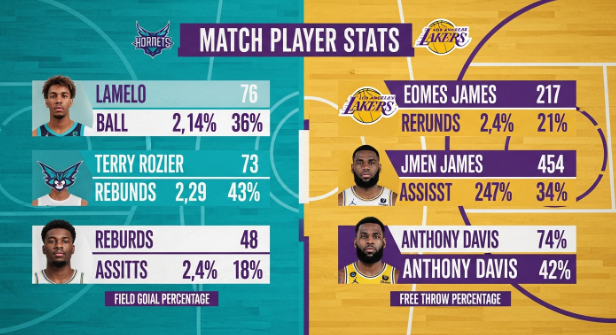
The Charlotte Hornets vs Lakers match player stats provide an essential insight into team performance and individual contributions. Fans and analysts rely on these statistics to understand which players dominated the game and how strategic decisions shaped the outcome. This comprehensive review highlights scoring, rebounds, assists, and defensive impact.
Scoring Leaders in Charlotte Hornets vs Lakers
Scoring remains the key factor in evaluating the Charlotte Hornets vs Lakers match player stats. For the Hornets, their top scorer contributed efficiently from both inside and outside the paint. Meanwhile, the Lakers relied on perimeter shooting and fast breaks to maintain momentum. Close observation shows how effective shot selection impacted final scores.
Rebounds and Defensive Impact
Rebounds determine control over possession and are crucial in understanding the Charlotte Hornets vs Lakers match player stats. Hornets’ big men excelled in offensive boards, creating second-chance opportunities. The Lakers focused on defensive rebounds, limiting opponents’ scoring chances. Strategic positioning and timing helped both teams influence the game defensively.
Assists and Playmaking Analysis
Playmaking defines team rhythm, and assists highlight passing efficiency. Charlotte Hornets vs Lakers match player stats reveal that key players facilitated scoring through precise ball movement. Quick transitions and pick-and-roll plays contributed significantly. Assists not only reflect teamwork but also indicate the offensive flow of each team during crucial moments.
Shooting Accuracy and Efficiency
Analyzing shooting percentages is vital for understanding player performance in the Charlotte Hornets vs Lakers match player stats. Hornets showed strong three-point accuracy, while Lakers excelled in mid-range jumpers. Effective field goal percentages highlighted the best shooters, demonstrating how shot selection directly influenced game momentum and overall scoring.
Turnovers and Mistake Management
Turnovers can swing momentum against a team. Charlotte Hornets vs Lakers match player stats indicate which players struggled with ball control. Lakers minimized mistakes through disciplined handling, whereas the Hornets faced challenges in fast-paced situations. Managing turnovers was essential to maintain competitiveness and maximize scoring opportunities.
Free Throws and Clutch Performance
Free throws often decide close games. Reviewing Charlotte Hornets vs Lakers match player stats shows how players handled pressure. The Hornets converted critical free throws efficiently, while Lakers capitalized on fouls to stay competitive. Consistency at the line reflected composure and clutch performance, affecting overall team confidence.
Bench Contribution and Depth Analysis
Bench players impact team stability and flexibility. Charlotte Hornets vs Lakers match player stats show meaningful contributions from substitutes, who provided scoring bursts and defensive support. Depth analysis demonstrates how rotations influenced fatigue management and helped maintain energy levels throughout the game, proving the importance of a strong second unit.
Conclusion
The Charlotte Hornets vs Lakers match player stats highlight individual brilliance and team strategy. Scoring, rebounds, assists, and efficiency showcase which players dominated and how the game unfolded. Fans, coaches, and analysts can utilize these insights to predict future performance. Follow player stats closely to stay updated with basketball excellence and team strategies.
FAQs
- Who were the top scorers in the Charlotte Hornets vs Lakers match?
Top scorers included players who excelled in perimeter and paint scoring, significantly impacting the game outcome. Both teams had standout contributors influencing momentum. - How did rebounds affect the game?
Rebounds allowed control of possessions, with Hornets excelling in offensive boards and Lakers focusing on defensive stability. Strategic rebounding shaped scoring opportunities. - Which players had the most assists?
Key playmakers facilitated scoring through smart passes and fast transitions, contributing to team rhythm and offensive efficiency. - Were free throws a decisive factor?
Yes, free throws under pressure influenced the game. Consistent conversions reflected composure and clutch performance for both teams. - How significant was bench contribution?
Bench players provided scoring bursts, defensive support, and energy management, highlighting the importance of depth in competitive play.